by volcom2278 | Oct 27, 2021 | Birth Trauma
“The great majority of humanity are ruled by their external circumstances, but the superior man is he who works out his own direction and then changes his environment, or his reaction to it, accordingly. He is a master of his destiny.”
~Gareth Knight, Authority on Western Mystery Tradition and Qabalistic Symbolism
Consciousness is truly the core of life and is the key to healing. Ultimately, consciousness is connection to the Truth, the Source, the great I AM, or the state of unconditional love. PPN theories focus on educating the public of this essential principle of consciousness: we, as humans, are conscious sentient beings from the beginning of life and prior to physical life here on planet Earth (McCarty 2012). Understanding this principle of consciousness is crucial to healing humans and creating a world that is safe, loving, and full of joy. PPN findings consistently show consciousness is a spiritual state of being, wholly connected to the creator source. Babies as embryos are closest to pure consciousness, but along the continuum of experience in the physical realm their connection to whole consciousness becomes fragmented by the mind, body and autonomic nervous system. Conditional forces, such as epigenetics, ancestral lineage, trauma, and life experiences influence all of these systems, and ultimately imprint upon a fetus’s true essence. Pre and perinatal dynamics explain how conditional forces in the earliest stages of life add layers on to consciousness in its purest form. Like an onion, these dynamic forces create the matrix that forms the central nervous system and lays the foundation for all the physical, emotional, behavioral, mental and spiritual aspects of a human. Consciousness is at the core of this matrix, unadulterated as the original blueprint, and is the portal to health, love and happiness.
Along the journey of life, we must recognize and become aware of the forces that influence our being and shape us into our unique form. This knowledge connects us to our whole consciousness in its non-dual form. Failure to recognize these forces leads to today’s society, which is hindered by illness, conflict, suffering, and disharmony. These states of being are polarities separated from the core of health, love, and harmony. The polarities are analogous to our subconscious or our Shadow side. The subconscious harbors the somatic memories and forces that fired and wired the central nervous system, and what we call “conscious” in everyday life, is our ego in present time. If we could mold the two, ego and subconscious, we would be fully aware of the forces that form us, and the nature of our Higher Self. We can in turn reach our full potential. Stan Grof reiterates this point in Psychology of the Future: Lessons of Modern Consciousness Research when he states, “We perceive that consciousness is wholeness and is nothing more than what we perceive in any given moment. However, what our minds perceive as consciousness is fragmented and disconnected from wholeness.” His statement reflects the theme of the movie The Matrix when Neo finally sees the code streaming all around him. He wakes up from his vast daftness and his own limited perceptions, and sees the true reality of the computerized Matrix in which his mind has been trapped.
The journey of life is rhythmic and configurational in nature in that conscious unfolds and then refolds into itself in a very specific, consistent pattern. We start with the creator in a unified field of Conscious and we unfold into physical form in which we perceive to sever from whole conscious. As we live in the realm of polarities, or conditional forces, we progressively work to return to wholeness, which finally takes place at the time of death when our essence departs from physical form. Great thinkers such as Francis Mott outline this universal design of creation and correlate it to everything we see in nature, asserting that the omnipresence of a single pattern and rhythm of integration can be found in all form, inorganic and organic, social and mental (Mott, 1964). The Hermetic principles “as above, so below” is inextricably bound to the universal design of creation on all levels of matter and in all dimensions of space-time.
The whole objective of studying consciousness, and in turn pre and perinatal psychology, is to develop a means to discover ourselves and welcome and embrace other humans in a protective, nurturing relational field. Knowledge is power and holds the keys to healing. Stan Grof speaks to holotropic therapy, which means moving toward or orienting to wholeness, as a means to healing trauma from birth and onward in life. He also indicates this name suggests a person’s everyday state of consciousness is fragmented making that person only a small fraction of who they really are (Grof 2007). William Emerson speaks about the healing potential found with somatotropic therapy, which is experiencing the felt sense of trauma stored in our bodies and providing a means for the innate Intelligence of the body to reorganize the energetic and physical manifestation of the trauma. Both therapies have the same end goal: to activate the unconscious and free the energy bound in emotional and psychosomatic symptoms, allowing for the experience to integrate into the whole and not hide in the shadows of the subconscious disconnected from the whole (Emerson 2002). PPN theories call society to acknowledge prenates are conscious, sentient beings governed by the same universal truths applicable to adults. Acceptance of these facts will promote healing and connection in all mankind. Refusal to acknowledge the nature of consciousness only results in the repetitive patterns of suffering. This lack of awareness affects babes who must marinate in the shadow aspects of their parents, grandparents, and more distant ancestors, causing them to become reactive in nature and governed by fear, desperation, and aggression (Emerson 2002).
Many spiritual parallels can be drawn from the theories of pre and perinatal psychology, such as seen with transpersonal phenomena. As a Christian mystic and student of Qabala, I love applying PPN theories to biblical stories that correlate with the universal pattern of creation as outlined by Francis Mott, who was a great contributor to the PPN field. Mott followed from the lineage of Freud and Otto Rank and his writings influenced Frank Lake, who was one of the first psychiatrists to describe the intrauterine life (Emerson, 2002). Francis Mott laid out his theory on the architecture of the mind as follows, “My theory of the mind’s nature was based upon the idea that there are four major mental organs, namely (1) the ego, (2) the emotional field, (3) the reason, (4) the will.” This same pattern corresponds to a fertilized egg. The fertilizing germ represents the ego, the surrounding plasm represents the emotional field, the developmental embryonic processes represent the action of reason, and the emergent chick represents the act of will to which creative impulsion gives rise (Mott, 1964). Mott applied these patterns over and over again to the vastness of the cosmos, the inner workings of our minds, and down to the simplest trajectory of a plant seed.
The Bible itself lays out the mysterious, universal pattern of consciousness unfolding, as seen with the three spiritual journeys of Moses, Elijah, and Jesus. The ego, or phase one, is the blueprint found in each human being, the great I AM. The I AM is the embodied kingdom of God we all carry within us. The name of God is only first revealed in the Bible to an unsuspecting prophet, Moses. The very name, Moses, in Hebrew means name, and when spelled backwards in Hebrew, it means heaven. The I AM is not tainted with imprints from the physical world, it must be drawn out from the subconscious. Until it is drawn out, it remains hidden, buried within the womb, unbeknownst to the world and identical to how an egg and sperm quietly develop. Thus, when God speaks to Moses on the mountain and he says, “I AM who I AM,” we realize that he speaks his name and his name must be inverted and drawn without to reveal the kingdom of heaven. This process of knowing God’s name was the first step to unfolding consciousness into a fragmented nature. The book of Exodus symbolically represents the beginning stages of mapping the human mind and uncovering the secrets of the subconscious. Moses leading the Israelites out of Egypt is the emotional field, or phase two, coming into play.
Joseph was the biblical character born of Jacob who led the Israelites to Egypt. The Bible documents his body being buried in Egypt and a new Pharoah, to whom Joseph was unknown, coming to power and enslaving the Israelites. Joseph symbolizes the wonderful human imagination, which is buried in Egypt, yet another symbol representing the human body. His body contains within itself the whole vast world, and now it has to be led out, a step symbolized by the body of Israelite people. The revelation of the true name of God, I AM, marks the beginning of Exodus and the initiation of phase two of the emotional field.
In the third phase of creation unfolding, reason comes into play. Elijah, another prophet considered just as great as Moses, symbolizes reason. This prophet contests the Israelites’ worship of Baal, Jezebel, and her priests. His fight for God represents reason in the form of might, disciplined resolve, and infinite power void of emotion and love. He marks the transmutation of states of being from emotion to reason when he transcends this world and enters into relation with God in the miraculous scene of his fiery chariot ascending into heaven. In this story, the horses symbolize the mind, which is harnessed, disciplined and directed by the charioteer, Elijah, who stands for infinite power of reason.
The fourth phase of creation is embodied with the Will of God. Jesus Christ is the final phase of creation unfolding outwardly and manifesting in the physical, sensory realm of Earth. Jesus is the perfected man, conscious of physicality as well as the Kingdom of God. He is the bridge between the worlds and the ultimate sacrifice for all those who must die in the flesh and be reborn again. He stands with Moses and Elijah on the Mount of Transfiguration where the disciple Peter reports they all shone until their faces were like the sun (Matthew 17:1-8). Jesus is the Light of the World, and this light is pure consciousness; the epitome of health, miracles, healing, and majestic relationship with God. The story of these three characters represent the three states of being that we all must pass through in order to become one again with our Creator. Jesus passed through these states and in the end he became one with the being who begot himself as Jesus.
In conclusion, pre and perinatal theories focus on consciousness is a means to teach us about the powers that shape us, and how we can resource ourselves to overcome the forces of trauma. Ultimately, by understanding the true nature of consciousness, we can change our perception of trauma. We live in a disconnected world in which we adhere to the perception that trauma severs us from the Creator force, or love. In reality, we are never severed from our Maker. Rather, we always carry the inner Intelligence to resolve and disperse the energetic imprints of trauma. Healing can happen, but we must tap into our consciousness and awaken to awareness of our behaviors and how they impact our world. The starting point is how we treat our babies, our most sacred of resources–making conscious decisions around birth.
References
Emerson, W. (2002). Somatotropic therapy. Journal of Heart-Centered Therapies Vol. 5, No. 2, pp. 65-90
Grof, S. (2007). Psychology of the Future: Lessons from Modern Consciousness Research. Downloaded from http://www.stanislavgrof.com/wp-content/uploads/pd…
Knight, Gareth. A Practical Guide to Qabalistic Symbolism. Weiser Books, 2001.
McCarty, W. A. (2012). Welcoming consciousness: Supporting babies’ wholeness from the beginning of life–An integrated model of early development. Santa Barbara, CA: Wondrous Beginnings Publishing. Section IV: Building an Integrated Model in Early Development.
Mott, Francis J (1964). The Universal Design of Creation. Bedford, UK. The Sidney Press. Chapter 1

by volcom2278 | Oct 27, 2021 | Birth Trauma
Module 4 of APPPAH’s PPNE Course: Neuroscience
By Christianna Deichmann
When giving a talk on pre and perinatal dynamics, the speaker must be cognizant of behaviors exhibited by people in the audience because the subject matter can be activating of the autonomic nervous system. These external signals such as elevated speech, anxious fidgeting, distorted facial expressions, increased pulse seen at the carotid artery, redness in the face or neck, and constricted posture can relay information regarding the internal states of each person. Inevitably, someone attending the talk will have unresolved early childhood trauma and will be triggered by the content, in turn pushing them into a state of arousal or dissociation that can be overwhelming and re-traumatizing. Since most people are unaware of their trauma or what drives their bodies to behave in certain ways, the speaker would want to encourage anyone activated by the talk to seek out somatic experiencing (SE) therapy.
Bringing awareness to the internal state of your autonomic nervous system and sensations within your body is like attending mind-body gym class. Peter Levine developed the therapy known as Somatic Experiencing, which empowers individuals with conscious awareness of how their autonomic nervous system is regulating. This form of therapy provides a safe container in which to discharge blocked energy and to relieve implicit memories of trauma that drive pathology, disregulated behaviors, internal biology, emotions and thought patterns. His therapy provides the roadmap for how individuals can access, tolerate, and utilize their inner sensations (Levine 2010).
Stephen Porges’s Polyvagal Theory greatly contributed to Levine’s techniques and forms the foundation of how psychophysiology plays out in the body. The theory describes three stages in the development of a mammal’s autonomic nervous system that are each supported by a distinct neural circuit: immobilization, mobilization, and social engagement (Porges 2004). These neural circuits are activated independently of conscious awareness. The nervous system evaluates risk in the environment and regulates the expression of adaptive behavior to mirror the neuroception of an environment that is safe, dangerous, or life threatening (Porges 2004). The nervous system responds in a hierarchal fashion in response to unsafe neuroception. First, the person will engage the social nervous system to secure collective safety. However, when “pro-social” behaviors do not resolve the threatening situation, a person mobilizes the flight-or-fight response. If this hierarchy of default fails to resolve the threat, the least primitive system, immobilization/dissociation, kicks in (Levine 2010).
The social engagement nervous system is the most advanced system and has to be developed extensively in order to overcome the more primitive defense systems of fight-or-flight and dissociation. John Chitty explains that people have to build up the neuronal connections between the lower parts of the brain to the higher more evolved parts in the pre-frontal cortex (Chitty 2013). A person in a pre and perinatal talk who is demonstrating behaviors of anxiety or unease would benefit from healing unresolved childhood trauma of which they may not be aware is hijacking their sense of safe neuroception. Before social engagement behaviors can occur, the nervous system must have safe neuroception (Porges 2004). Levine points out in his book In An Unspoken Voice:
Traumatized individuals have lost both their way in the world and the vital guidance of their inner promptings. Cut off from the primal sensations, instincts and feelings arising from the interior of their bodies, they are unable to orient to the “here and now.” Therapists must help clients navigate back to their bodily sensations and capacity to self-soothe.
This type of mind-body therapy builds neuronal connections between the brainstem, amygdala/thalamus, and the neocortex. Someone who does not have resiliency in their nervous system, or the capability to utilize social engagement, has undernourished self-regulation capacities.
APPPAH’s mission is to change how the world perceives and treats babies. With current cultural trends, birthing practices, and hospital environments, babies enter this world with compromised opportunities to build strong neuronal pathways within the social engagement part of their autonomic nervous system. Chitty describes in Dancing with Yin and Yang how the whole hierarchal nervous sequence breaks down in a sub-optimum hospital birth. Newborn babies are often separated from their mothers, neglecting skin-to-skin contact necessary for oxytocin release—another neuropeptide crucial for building neuronal connections to the neocortex (Porges 2004). They are subjected to painful, unnatural procedures, coupled with medicine’s belief that babies are unaware with unsophisticated nervous systems. Baby’s social engagement system impulses are thwarted, so baby resorts to the sympathetic ANS in the form of crying. If this tactic fails, the baby’s only option is the parasympathetic freeze/immobilization response (Chitty 2013). Pre and perinatal dynamics describe issues and patterns that come from mother and baby’s experiences during preconception, conception, intrauterine life, birth, and the postnatal period. These experiences lay the foundation of the autonomic nervous system and ultimately shape who we become. Therefore, this subject matter can activate people who harbor trauma during this vulnerable time period and trigger implicit memories embedded in their bodies.
People who get activated by hearing talks on pre and perinatal dynamics need to connect with their bodies to understand the psychophysiology underpinning their behaviors. Psychophysiology denotes the translation of emotions into bodily, material processes involving the hormonal, cellular, and neural aspects of bodily being (Weinstein 2016). The Polyvagal Theory and Somatic Experiencing (SE) therapy demonstrate that there is no such thing as body-less thoughts, perceptions, emotions, or sentiments, because every internal and external force/condition/experience generates a response from the nervous system, which in turn governs how the body functions (Weinstein 2016). John Chitty said uplighting the social engagement system is the new “holy grail” of therapy, health care and childcare (Chitty 2013). In conclusion, somatic practitioners trained in SE are best equipped to help individuals heal from early childhood trauma.
References
Chitty, J. (2013). The autonomic nervous system. In Dancing with the yin and yang. Colorado School of Energy Studies website.
Levine, P. (2010). In An Unspoken Voice. How the Body Releases Trauma and Restores Goodness. Berkeley, North Atlantic Books
Porges, S.W. (2004). Neuroception: a subconscious system for detecting threats and safety. Zero to Three, May 19-24.
Weinstein, A. (2016). Prenatal development and parents’ lived experiences: How early events shape our psychophysiology and relationships (Norton Series on Interpersonal Neurobiology). NY: Norton Press. Chapter 7.
by volcom2278 | Oct 27, 2021 | Birth Trauma
Consciousness Streaming:
Module 3 Epigenetics Art Submission and Essay
By Christianna Deichmann
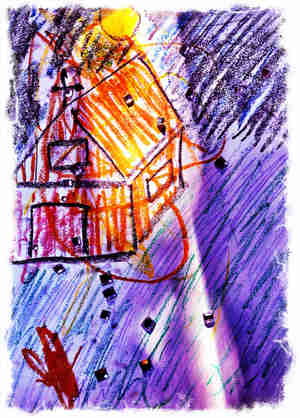
My son and I made this piece of art together while I told him the story of when I first acknowledged his being on the night of September 14, 2016. I had felt his presence building in the weeks prior to his conception. On the evening of his conception, I felt a moment of pure rapture, ecstatic energy rising up from the depth of my loins. I will never be able to convey in words the genuine state of grace and joy I experienced. I simply felt entirely “connected” to true love. Shortly after these moments, I stepped outside onto my deck under a canopy of stars, and I saw a waxing moon, a glowing orb of golden and yellow hues, just starting to rise over the tree line in our back paddock. I told my son, I felt his spirit stream down towards me, transcending from the invisible realm. As I told him the story of how I welcomed him into this world with joy and love, he scribbled away around the barn and carefully placed his diamond stickers in an order which I could only imagine mirrored his descending path towards my physical body, until he finally converged with egg and sperm, resting as a zygote in dynamic stillness.
My son and I’s journey together through conception, pregnancy and birth provides an anecdotal account to support the latest research in epigenetics and pre and perinatal psychology proving babies are aware, sentient, expressive and connected with their mothers and affected by their interactions with people as summarized by Chamberlain (1999). During my first trimester, I was under a great deal of marital and job-related stress. My husband did not want to confront another pregnancy or the financial burdens children bring. As outlined by Dr. John Upledger in A Brain is Born, crucial stages of development take place within the embryo between 4-7 weeks that entail the folding of the neural tube, induction of the spinal cord, construction of the four-chambered heart, and development of the neural crest that lays the foundation of the palate shape and the fascia structures (p. 51-68). My son was born with a number of midline defects that I instinctively know were associated with the mental, physical, spiritual and emotional stress I was experiencing during those first eight weeks of his development, coupled with the fact that I have the MTHFR gene mutation that inhibits my body from processing folic acid and converting it to folate at an efficient level (Eske, 2019). I would go as far to say that this gene “mutation” is most likely a “silenced” gene brought on by a troubled childhood and trans-generational trauma from which my parents and grandparents suffered. The medical staff in the labor and delivery unit documented upon his birth a sacral dimple (a harmless early phenotype of spina bifida), a heart murmur, a posterior tongue-tie, and hypospadias. Odent’s article on “Womb Ecology” (2006) documents:
The increasing rates of male genital tract disorders are also related to intrauterine pollutions, giving way to increased incidents of cryptorchidism, hypospadias, cancers of the testicles, and reduced average sperm counts. The most plausible interpretation is that many synthetic chemicals accumulated over the years in adipose tissues are hormonal disrupters (more precisely “estrogen mimickers”); they interfere with the development of the testis at the very beginning of intrauterine life.
My first trimester presented challenges, but I did everything I could to connect with my child throughout my entire term. Once my husband made the conscious decision to accept the news and welcome our child into the family, I sensed a dramatic shift. When I rested in the evening after a long day of work and I writhed about on the couch, uncomfortable in any position with itchy legs, my child would roll around, kicking and squirming. My husband could put his hand on my belly and both my son and me would settle. After this shift, my son would in turn gently poke back at his father’s hand. Those moments of connection were truly wonderful, and a sense of peace would fill the room and love between my husband and I amplified. The space would widen. Chamberlain outlines in “The Fetal Senses” how reactive listening has been recorded to take place as soon as 16 weeks of gestation, and the entire repertoire of fetal motions are online by 14 weeks (p. 1-2). I definitely experienced my children listening to me in the womb with both pregnancies.
I wish my dream of vaginal birth and connection to my child in those few precious moments following birth were a reality for me, but they were not. My obstetrician was very much a part of the 19th century view of babies. He insisted I have a C-section because a VBAC was too risky. He disregarded the importance of handling a baby gently, or the crucial moments after birth when a child should go to breast. I do not hold him to blame, though, rather the systems in place and how universities educate our doctors and nurses. My son was only shown to me for a brief second before he was rushed off to the NICU, where he was poked and prodded, inserted with tubes and isolated to an incubator crib where he lay under bright lights with only a diaper. With the shock and trauma of the C-section his muscular physiology was twisted, torqued and wrought with trigger points. He couldn’t latch at the breast or effectively breast feed without wearing himself out and causing severe pain for me. He slept long hours and seemed to disassociate easily from the world. My family surrounded him with love, though, and knowing what I knew from my daughter’s C-section and how her behaviors of anxiety and food allergies progressed, I was determined to not let his story unfold in the same way.
Bruce Lipton described how “maternal behaviors and emotions profoundly impact the child’s physical development, behavioral characteristics and even its level of intelligence” (1998). I knew from my own pain journey that healing takes place in the present time and the science around neuroplasticity supports the fact that the body can recover from trauma and our physiology can change. We can grow our brain and stimulate our children’s brains with set intentions. Science is now showing that DNA can be altered and “corrected” in the presence of love, because love simulates an environment that activates specific biochemical pathways in our bodies that promote growth versus protection mechanisms. The old school of thought around genetic determinism has been usurped by living biodynamic systems that are capable of reprogramming gene behaviors (Lipton, 1998). So, I sought out craniosacral therapy for my son shortly after his birth and I worked diligently to get him to breast. I slept with him. I refused to believe in the cry it out method. I was present for his every need. When he was sick, I treated him with botanicals and natural remedies. I would shower with him in the middle of the night to get steam in his lungs when he suffered from horrible colds. He slept swaddled and on his stomach, he loved it. I massaged him multiple times a day, used acupressure points, sang to him, told him stories about his birth in his sleep.
I truly believe Lipton’s comments on the role of “nurture,” and how it plays an essential role in shaping the characteristics of living organisms (1998). Love is our most powerful tool to changing this world and bringing light into darkness. Babies are leading us to the dawn of a new age, a time for a new paradigm, for a world that sees babies for what they are: super sentient, intelligent beings that are consciously connected to the primary source of life. If we could only become more like children, present and conscious of this creative force permeating all quantum fields and dimensions, this world and all the problems humanity faces would shift. My artwork created shows my son’s consciousness streaming into the tangible kingdom in which we inhabit, but yet we are surrounded by invisible worlds. The key to this invisible world is heart to heart connection. Let it start with our babies who are the bridges between the worlds.
Chamberlain, D. (1999). Babies are not what we thought: Call for a new paradigm. Journal of Prenatal & Perinatal Psychology & Health 14(½) 127-144.
Chamberlain, D. The fetal senses. From http://www.birthpsychology.com.
Eske, J. (2019, August 29). “What is an MTHFR mutation?.” Medical News Today. Retrieved from https://www.medicalnewstoday.com/articles/326181.php.
Lipton, B. (1998). Nature, nurture and the power of love. Journal of Prenatal & Perinatal Psychology & Health 13 (1), 3-11.
Odent, M. (2006). Womb ecology: New reasons and new ways to prepare the prenatal environment. Journal of Prenatal & Perinatal Psychology & Health 20(3), 281-289.
by volcom2278 | Oct 27, 2021 | Birth Trauma
This essay was submitted to APPPAH for the Pre and Perinatal Educator certification and discusses Ethics within this field. Specifically, the paper addresses C-sections and VBACs and the ethical situations we run up against with the birthing rituals established in the westernized world. Upholding natural birthing practices versus technocratic models would be a huge step in implementing the paradigm shift to conscious parenting. We must be mindful of how these conversations are approached and be ethical in our mannerisms and principles.
As a pre and perinatal psychology educator, my greatest ethical challenges revolve around the principles of respect and responsibility to do no harm. APPPAH’s core mission is to bring consciousness to birthing practices, parenting skills, and psychology in a world that is for the most part unconscious to the scientific process of human development and how these processes provide the foundation for health and joy or disease and misery. The irony of this educational mission lies in the path of obtaining consciousness, which is littered with subconscious triggers that set off imprints and patterns laid out by a person’s autonomic nervous system during their earliest periods of development. In order to tackle such a jarring journey, I have to uncover my own patterns and states of being within my own autonomic nervous system (ANS). In turn, I can then recognize how neurophysiology governs the mind, body, and spirit of another person’s ANS.
Along this journey of self-discovery and training, I have found the most difficulties in adhering to these two ethical practices of respect and “do no harm” when addressing health care providers such as OB/GYNs, their support staffs, and pediatric dentists on the topic of supporting normal, natural birth processes during pregnancy, birth and breastfeeding. Currently, the majority of these healthcare providers do harm to mothers and babies by practicing non-natural techniques. When trying to educate them on the benefits of supporting natural processes, I must remind myself to respect how they were birthed, raised and educated in order to form such practices. My own personal experience of birthing my second child exposed me to how the current medical modalities practiced violate the Lamaze code of ethics and the Ten Steps of Mother-Friendly Care.
When I learned I was pregnant with my second child, my OB/GYN insisted that I opt for a cesarean delivery. I wanted to attempt a VBAC, and if I had been allowed to, I would have also sought out a midwife or doula to help me through the pregnancy. Whether he was aware of his tactics or not, my doctor scared me into a C-section by informing me of the risks I would incur if I attempted to deliver naturally. Namely, he said my uterus could rupture and if that happened my child would surely die and most likely me as well. I spoke to a few other mothers who had tried VBACs, but their doctors refused to attend VBAC deliveries. According to the American College of Obstetricians and Gynecologists (ACOG), a mother’s uterus has less than a 1 percent chance of rupturing at the site of a C-section scar if a vaginal birth is attempted (Enking). My doctor said the odds were low, but why would I want to take the chance because the consequences would mean sure death. My husband was so concerned about this statistic and the doctor’s recommendation that I felt my only option was to follow through with a C-section.
Hospitals list different reasons for why repeat C-sections take place, including that doctors can become more efficient with their schedules versus waiting for a patient’s labor to progress naturally. A new review suggests doctors may choose C-sections to guard against malpractice lawsuits (Enking). Providing better education to doctors and hospitals regarding the importance of VBACs and respecting women’s inherent abilities to deliver children naturally is one way to decrease the staggering rate of C-sections around the world. The best way to fight back is with science itself.
Many studies have been conducted on how to lower risks involved with VBACs. These studies should be shared and included in curriculum for OB/GYNs in medical school and condoned by governing boards such as the American Board of Physician Specialties. These studies observed women who received continuing midwifery care during pregnancy, labor and postnatal care and compared them to women who only received standard maternity care. What they consistently found is VBACs pose less threat when handled with a continuing midwifery model of care. C-sections can bring benefits for women in labor, but they result in more risks, including more pain, longer and difficult postpartum recovery, higher maternal mortality and morbidity, difficulty in conceiving, as well as high rates of stillbirth and miscarriage in subsequent pregnancies (Zhang, T. & Liu, C.).
When I returned to my doctor to explain some of the things I had learned from my studies with APPPAH, he became very defensive and was not willing to hear what I had learned about midwifery as a support model for VBACs. I wondered what triggered him so much, but I have no knowledge of his past experiences or what it is like to be an operating physician with such huge responsibilities on my shoulders. I resisted the urge to emphatically insist that he did me harm and he held no regard to my body’s capabilities to birth a child naturally. I could have badgered him with my anger and lack of respect for the medical community overall.
I know now I could help reduce his stress if I approached him in a different way by using Michael Josephson’s Seven-Step Path to Better Decisions. By following the steps he outlines, I would gather a number of peer-reviewed studies on how midwifery care supports women who choose VBACs. These studies could be presented to medical boards and governing boards of the hospital that oversees his employment. I could even introduce the steps of Mother Friendly Childbirth Initiative to nurse coalitions in the area of his practice to better educate them on how to best support natural processes during labor and delivery. I could develop multiple relationships within his own professional community to increase my chances of impacting his opinions in a positive, influential manner (Josephson Institute of Ethics). By working on my own self-regulation of my autonomic nervous system, I can train myself to stay in a focused state of mind and communicate with medical professionals on this topic in a calm, regulated manner with my overall objective constantly in mind. Ray Castellino’s Principles are also extremely useful for how I can conduct myself ethically when trying to educate people on VBACs. His use of frequent eye contact and self-care are extremely important in establishing a safe container for people when speaking of such controversial issues as VBACs (Castellino).
Mutual support and cooperation takes a great deal of time and effort and if communications can be kept intentional, calm, and backed by facts and scientific studies, we can bring people’s awareness to how VBACs should be embraced rather than shunned. By practicing the principles outlined by Castellino and Josephson, I can avoid doing harm myself or disrespecting the professionals in this field who have come a long way with their own education and experiences.
References
Castellino, Ray. The Principles Interview. Retrieved from APPPAH’s Ethics Module 2 Curriculum.
Enking, Molly. (2018, August 12). After a C-section, women who want a vaginal birth may struggle to find care. Health. Retrieved from https://www.pbs.org/newshour/health/c-section-vbac-vaginal-maternal-health
Josephson Institute of Ethics. “The Seven-Step Path to Making Ethical Decisions.” Retrieved from http://josephsoninstitute.org/med-4sevensteppath/
Zhang, T. & Liu, C. (2016 May-Jun; 32(3): 711–714). Comparison between continuing midwifery care and standard maternity care in vaginal birth after cesarian. Pakistan Journal of Medicine. Retrieved from https://www.ncbi.nlm.nih.gov/pmc/articles/PMC4928428/
Download Babies are not what we thought pdf
by volcom2278 | Oct 27, 2021 | Birth Trauma
This is an essay submitted for the Pre and Perinatal Educator certification course at the Association of Pre and Perinatal Health. We are calling for a paradigm shift in human consciousness…join the mission in redefining our lives and the world our children will inherit.
Module 1: PPNE Foundations
Poem Collections and Essay by Christianna Deichmann
As the world evolves and the human race approaches new heights of scientific discovery and technology, our minds are opening to the realm of possibilities existing outside of our present states of consciousness. I want to be a part of this renaissance in order to truly know myself and in turn heal myself from trans-generational baggage that has shaped my life. I was attracted to APPPAH and the PPNE program because it teaches people how human beings develop, why they adapt specific behavior/attachment patterns and ultimately how disease is linked to patterns established in the earliest stages of development. The body of knowledge collected by APPPAH provides resources for people to become more conscious of how they regulate themselves and ultimately how they can heal from past trauma. My present goal is to nurture resilience in myself, rewire my mind, and become connected to the inner-workings of my body. In turn, I can link these truths so that I may become a well-regulated body-mind-spirit trinity. With this goal set in motion, I will take this knowledge and teach it to my children, other families, and be a part of the paradigm shift to make this world a more peaceful, healthier, loving planet.
Today, scientific studies span the frontiers of quantum physics to epigenetics, and usher forth the truth of how interconnected every form of life and even inorganic matter is from here to the far distances of the galaxy. Kate White and Jean Rhodes outlined in their article, “Summary of Trends and Influences in Pre and Perinatal Psychology,” how therapies over the past hundred years have progressed from behavioral and psychological study to somatic therapy, and ultimately integrated neuroscience, epigenetics and somatic experiencing (White and Rhodes, 2014). All of these paradigms link how our brains and bodies are wired to communicate. The field of neuroscience reveals how neural pathways manifest into our thoughts, beliefs, behaviors, attachments and diseases. APPPAH has taken on the monumental task of assembling a multitude of scientific disciplines into a field explaining how babies experience the world and how these experiences determine who they become as adults. APPPAH speaks for those who do not have a voice, and acts as the bridge over which adults can cross from the realm of disconnected turmoil to the side of connection, love, joy, coherence and spirituality (Morningstar, Voices of the Children).
My experiences as a mother and past trauma led me on a journey of self-discovery and healing, and eventually to APPPAH and the PPNE course. The principles this organization wishes to voice to the world, I have witnessed first hand. I constructed three poems after completion of Module One in hopes to document the embodied experiences I felt birthing my own children and to attest to the truths of the core principles laid out by APPPAH and the literature included in Module 1 of the PPNE course.
The first poem, Conception, echoes APPPAH’s mission statement described by Sandy Morningstar in Voices of the Children. I experienced both of my children’s moments of conception—two unforgettable experiences that imprinted themselves on my mind and body. Both of my children communicated with me on many levels, subconscious and conscious. APPPAH proclaims that babies are sentient beings and it is our responsibility as humans to make a collective effort to understand how they are communicating with us in order to provide healthier people for the world (Morningstar, Voices of the Children). I felt connection with both of my children when I carried them. I also remember both moments of conception and how joyous and replete I felt.
Conception
You emerged as a thought—a thin vapor—
An essence from the Land of Nought,
One moment a shimmer, the next forgot.
As time passed, thoughts coalesced;
Implanting roots, like a seed.
Followed by shoots bursting forth,
Shining light into deep conscious;
Dissolving the veil between inner and out.
During my slumbers at night,
You weaved your story in patches,
Bits and pieces taking flight;
Forging a majestic tapestry of truth and delight.
Fleeting smiles of love and rapture,
Connected and conscious.
Gone in an instant at first morning light.
The moment of conception, swift and sure,
Came on the eve of a full moon, September 14th.
A wave of ecstasy, powerful and pure,
Converged into a crescendo, perfect and secure.
Your spirit called me and I looked up.
I felt your celestial orb drift down on the soft moonlight.
To pen these words now, tears swell up,
For that moment imprinted such awe to feel
Love, joy and life collide and unfold henceforth.
No words can express that moment on that night.
At long last, you swelled inside my heart.
A being, alive, and manifest,
Buried deep in my womb,
full of love, light and everything best.
The second poem I scribed, Numb, recounts the birth of my second child, who was a C-section baby. He turned out to be transverse in the womb and stuck in one side of my uterus. The doctor discovered I had a bicornuate uterus, or heart-shaped uterus. He was unable to pull my son out without using additional surgical means. He performed a T-incision and ended up administering drugs to stop my uterus from contracting. Ultimately, he ripped my son out by his left arm. The pediatrician thought my son’s arm was broken, and had to resuscitate him immediately following delivery. His APGAR score was a 2. Shortly after resuscitation, the pediatrician found that he had a sacral dimple and hypospadias. The entire experience was incredibly traumatic for both my son and me. He was unable to breastfeed for two months, but he also had many midline defects that I believe happened at key times in development when I was extremely stressed. My son’s conception was not welcomed news by my husband, and we fought intensely between weeks 3-7 of my first trimester, when the spinal cord is being enclosed, as well as crucial formation of the pharyngeal arches that give rise to key organs and palate structures (Upledger, 1996). My son was born with a sacral dimple, meaning he had a chance of being born with spinal bifida; however, he was lucky that the tissue was sealed enough to encapsulate the spinal cord. Weinstein (2016) documents how maternal perceptions impact the prenatal environment, in addition to the role of epigenetics and how the prenatal environment impacts how genes are expressed (Weinstein, Chapter 3 and Chapter 8). I cannot help to wonder how my past experiences as a child, the experiences of my mother’s childhood, and my stress levels during pregnancy contributed to the birth defects in my son. Even the shape of my own uterus is a congenital abnormality. My grandmother struggled to give birth to her third child. She was separated at birth from him and hospitalized for two months while her newborn babe was sent to another family’s home to be care for and her other young children (including my mom who was 4) were sent off to another state to live with cousins.
When considering my mother’s traumatic experiences in childhood, I do not find it coincidence that I have an ACE (Adverse Childhood Experience) score of 4, and I struggled immensely as a child trying to adapt to my mother’s temperament and behaviors as an adult. I often try to pick her memory of the Primary Period she experienced with me. She hardly remembers her pregnancies. Ann Weinstein (2016) lays out the twelve guiding principles of prenatal and perinatal psychology in Chapter 2. I know my core blueprint, continuum of development, and innate needs were all compromised. During my lifetime, I have struggled to communicate with my mother or even bond with her. Our relationship is tarnished with anger, resentment, guilt, shame, frustration, criticism, and deep sadness. The primal period with my mother was followed by her divorce from my father. Underlying patterns were already entrenched in my brain development. I now recognize through Leading Edge training with Kate White, and studying attachment behaviors, I exhibit an attachment style of anxious and disorganized (Thompson, 2012). Despite all of the compromises, I truly believe in principle 10, Resolving and Healing, and principle 4, Capacities and Capabilities. By seeking professional support and pursuing my own line of study to discover who I am, what underlying patterns govern my behaviors and lurk in my subconscious, I am resolving past traumas and even breaking the curse of past traumas that afflicted my ancestors. As Ann Weinstein (2016) quoted from Natural Family Living—Right from the Start (2008), I know by resolving and healing my own unresolved issues from my child’s pregnancy and birth, my children will benefit at any age.
Poem 2: Numb
Lights overhead, sterile and cold,
My body lay prostrate, vulnerable and numb.
My husband to my left, the doc on the right,
The anesthesiologist hovered just behind me,
Blocking the outside light.
Fear welled up inside me,
I clutched my husband’s hand,
Squeezing out all life.
I braced myself, for choice and
All control was long gone from sight.
I could feel my upper body sway and rock,
Somewhere below, I could sense tugs and pulls,
Nothing felt right.
My husband kept whispering,
You’re going to be alright.
But my throat was dry and tight,
Nothing felt right.
I felt cold and dumb, no control, no choice—
Just pushed out thought with all my might.
An eternity passed,
As if time had slowed and space opened up.
Nothing was right.
I gripped my husband’s hand in a death vice.
I began to rock back and forth, pushed and tugged.
I lay limp and numb.
Suddenly, my heart throbbed,
Pounding my chest and rising up,
Into my throat, thick and tight, as if it was
Pushing back, giving its own fight.
The doc said to administer some drug,
I didn’t know what.
The anesthesiologist questioned his call,
Was this just? I don’t know,
I was numb and dumb, cold and scared,
Fighting for my life.
Seconds later, from what I could tell,
My heart pounded harder and harder,
Until I had no breath.
I opened my mouth, I heard my own voice,
“I can’t breathe!” Pause.
I had no effect.
I heard it again, with more urgent force,
“I can’t breathe!”
It didn’t matter, I got no response,
As I lay prostrate, rocking back and forth.
Panic and calm, dueling in my blood.
I heard in the distance,
Commands and orders barked,
Nurses rushing, calling out, everything harsh.
Somehow I knew my boy, Tom,
He was out. But I heard nothing.
No cry, no yell, no scream.
Again I felt silence so harsh.
Only a moment ago, time felt slow and expanded.
No longer, everything sped up, like a blur.
I couldn’t grasp onto any thoughts.
There I lay, splayed out, helpless and numb.
No baby, no baby, where had he gone?
My husband. He was there.
I looked to my left, he had been there all along,
Reassuring and so strong. I knew him and loved him,
But somehow he was so far, like I peered towards him
Through a long tunnel I had to cross,
An endless vortex, spiraling inward pulled me back,
Deep, deep, and dark, so very very wrong.
Nothing was right. Dead. Dumb. Numb.
I lay prostrate, no voice, no choice.
Nothing was right.
I looked him dead in the eye.
I pushed forth out from the cold,
I felt his hand, his grip, firm and strong.
Then I said, “Where is he Fred?
Where’s my boy Tom?” I knew before,
In that vortex, in those seconds,
I felt my son, his heart stopped.
I had plunged deep in something,
Endless and void.
I came to again, in that moment,
I felt a surge of life, bursting forth.
I pushed with sheer will and might.
This day I would birth
A light so bright into this world.
I knew of his strength.
I felt it every night, when I lay quiet,
Wondering who he might be,
One day in this life.
Before I knew it, Tom was there.
My husband said, “Here’s your son.”
I looked and our eyes locked.
I saw him. He saw me.
Magic. It was, pure and raw,
A connection that assured me,
Everything would be alright.
Only seconds we had, and he was gone.
Swept down the hall, his heart calling me.
Full of fear, full of tears, terror and strife.
They told my husband he should go,
Follow our son. He was off to the NICU,
As I lay numb and in shock.
I couldn’t sort the questions,
Jumbled and caught—suspended in ether
Somewhere in the artificial, sterile light.
I heard nurses telling me I would be alright.
Their voices, distant chimes,
Down that damn tunnel of darkness and fight.
Frustration surged, ramming against fear,
Somewhere the anger hid, scorched in my skin,
Permanent and hot.
What the hell just happened?
I knew not.
I lay dumb and numb,
Splayed prostrate and caught.
After surviving the birth of my son, I learned by the second day that he could not breastfeed due to a tongue-tie. All the same patterns I saw with my daughter were playing out in my son, only his were magnified. I refused to face the chronic ear infections, the tooth decay, the sleepless endless nights, the fierce anxiety my daughter fought constantly, the violent outbursts lasting for over an hour and cyclically occurring throughout the day, the constant stomach aches and abdominal pains. She suffers from brain imbalances and poor muscle tonality that I instinctively feel are linked with trans-generational trauma, my own stress, and the stress she experiences from the toxicity of our chemically manufactured foods. I knew I had to seek help beyond myself and question everything I had been taught. Like I said in my poem, Numb, I knew these patterns were not right. Kate White and Myrna Martin (2012) shared in “Pre and Perinatal Experiences for Health and Healing,” how parents can gain better understanding of their physical, emotional and spiritual inheritance by understanding environmental and health patterns in their ancestral lineage. I was convinced that my childhood and my relational patterns with my mother, and intimate partners were indicative of the lack of connection I felt in my youth, and the trauma I had experienced in my own home.
So, I began my journey to healing and became trained in craniosacral therapy and Kabbalah with the Modern Mystery School. I sought many avenues of professional help, ranging from somatic therapy, craniosacral therapy, and sauna detox. I researched attachment patterns and joined Kate White’s Leading Edge classes to understand how to control my actions when activated. I began to become conscious of my behavioral patterns. As I became aware of how I felt, what factors and situations triggered me, my behaviors began to shift, and my family has been recovering day by day. We are building towards health, happiness, connection and love. Healing is possible at any point in the present time, regardless of what difficulties have taken place (White and Martin, 2012). The universe is calling for me to heal. Every moment it presents the opportunities for healing to occur. So, I will sum up my paper with this last poem to dedicate this journey I am on with the PPNE program.
Listen
“Listen to me. Hear my call.
Hope is upon you, an elixir to cure all.
Breathe deep. Feel me—Your Heart—
Grow big and strong.”
I close my eyes, I feel your beat.
Da-dum, da-dum rising with heat
Swelling inside, your field so complete.
Your resource is constant, yet discrete,
Hiding beneath, beat after beat.
“Hear my voice.
Listen now. Feel my force.
I know what you need.
Healing will come, all in due course.
Just trust. Live and love.
Draw from my source.
Your heart, your true resource.”
References
Morningstar, Sandy. The Voices of the Children. APPPAH Mission Statement.
Thompson, R. (2012). Consciously Parenting: What It Really Takes to Raise Emotionally Healthy Families. (5), 68.
Upledger, J. (1996). A Brain Is Born: Exploring the Birth and Development of the Central Nervous System, 33-75. Berkeley, CA: North Atlantic Books.
Weinstein, A. (2016). Prenatal Development and Parents’ Lived Experiences: How
Events Shape Our Psychophsyiology and Relationships. New York, N.Y.: W.W. Norton & Company.
White, K., Martin, M. (2012, Winter). “Pre- and Perinatal Experiences for Health and Healing.” Pathways to Family Wellness, 36.